Thematic Sequences

Three thematic sequences are housed in the history department:

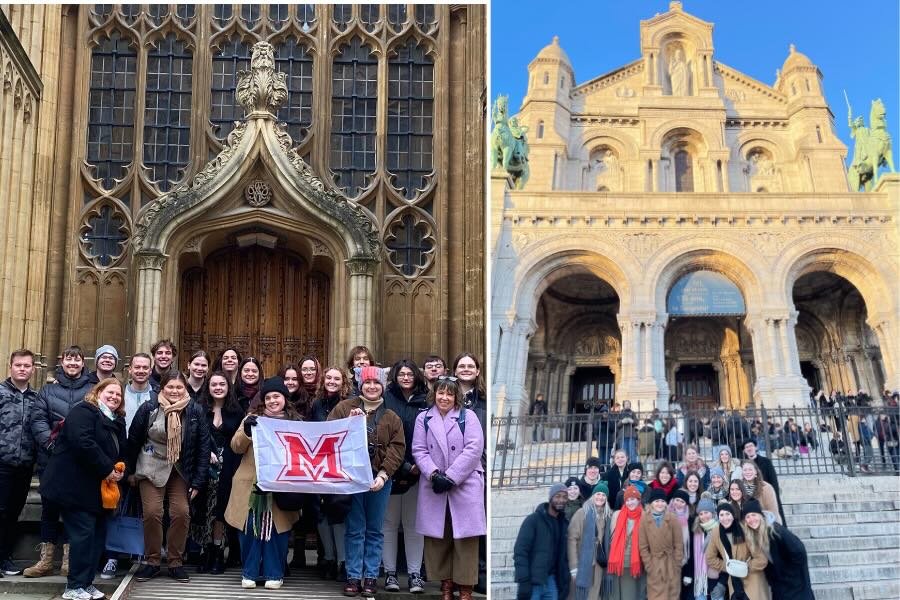
HST 1 - Medieval Studies

Seeks to enhance your knowledge of and appreciation for the history, art, and literature of the medieval period, as well as establish a full cultural context on which you can build an understanding of more recent history.

Select two courses from the following:

  • HST 246  Survey of Medieval History (3), or
  • ART 313 Early Christian, Byzantine, and Islamic Art (3), or
  • ENG 327 Medieval Literature (3)

And one course from the following:

  • ART 480W Feminist Art Histories (3), or
  • ARC 405G Seminar on Gothic Architecture (3), or
  • HST 346 Medieval Jewish History (3); or
  • HST 451 Social History of Medieval Europe (3), or
  • ENG 440 Major English and American Authors (3)*
    ENG 440 topics may vary from semester to semester. Consult with the sequence coordinator or the Office of Liberal Education to see if the topic can be applied.

Note: Majors in architecture, German, art, English, history, and Spanish must select a minimum of nine hours of courses outside their department of major.


HST 2 - Women and Gender in History

Studies the construction and nature of gender roles with particular emphasis on women, in a variety of historical contexts, places, cultures, and socioeconomic and political conditions. Encourages thought about whether there are any universal themes and questions regarding gender roles that transcend particular circumstances.

Select three courses from these options:

  • ART 480M Special Topics in Medieval Art (3)
  • ART 480W Feminist Art Histories (3)
  • CLS 235 Women in Antiquity (3)
  • HST/WGS 381 Women in Pre-industrial Europe (3)
  • HST/AMS/WGS 382 Women in American History (3)
  • HST 383 Women in Chinese History (3)
  • HST/AMS 392 Sex and Gender in American Culture (3)
  • HST/WGS 450 Topics in Women's History (3)
  • REL 334 Women's Religious Experiences in the Mediterranean World (3)

Note: Not open to majors in the Department of History. Majors in the departments of Art, Classics, and Comparative Religion must select a minimum of nine hours outside their department of major.


HST 3 - Russian, East European and Eurasian Studies

This Thematic Sequence examines Russian, East European and Eurasian history and politics from a multidisciplinary perspective. The Sequence allows students to study the history and politics of Russia and the former Soviet republics, from medieval times to today. Drawing from a range of disciplines and approaches, students have the opportunity to explore historical patterns, and political movements and parties from the 10th century to present. By considering this interaction, students gain meaningful insights into the development of this region as well as acquiring useful perspectives on western society. Because many of these courses are cross-listed, students from many different majors will be able to take the sequence by enrolling in the course through a department other than their major. Take one course from each tier.

1.

  • REL/HST/RUS 133 Imagining Russia (2)
  • ATH/HST/POL/REL/RUS 254 Introduction to Russian and Eurasian Studies (3)

2.

  • ATH/RUS 306 Russia and Eurasia: Anthropological Perspectives (3)
  • HST 324 Eurasian Nomads and History (3)
  • HST 374 Russia to 1855 (3)
  • HST 375 Russia and the U.S.S.R. from 1855 to the Present (3)
  • HST 428 Russia's War and Peace (3)
  • REL 235 Religions of Russia and Eurasia (3)
  • POL 331 Development of the Russian Polity (3)

3.

  • ATH 384 Anthropology of Capitalism: Russia (3)
  • GEO 307 Geography of Russia (3)
  • GEO 408 Geography of the Silk Road (3)
  • POL 328 Politics of Central Asia (3)
  • POL 332 Post-Soviet Russian Politics (3)
  • POL 334 Politics of Eastern Europe (3)
  • ITS 402O Transition to Democracy (3)
  • HST 436 Havighurst Colloquium (3)

© Miami University | 501 East High Street | Oxford, Ohio 45056 | 513-529-1809
Equal opportunity in education and employment | Trouble viewing this page? accessibility@muohio.edu
Privacy Statement | Miami University is a smoke-free environment.